Overview
The DIN 766 chain is a widely used standard in various industries, including manufacturing, material handling, and marine applications. Understanding DIN 766 chain specifications is crucial for professionals working with chains to ensure the durability, efficiency, and safety of the equipment. This guide provides a comprehensive overview of DIN 766 chain specifications, their importance, and how to select the perfect chain for your application.
Key Features of DIN 766 Chains
1. Material: DIN 766 chains are made from high-quality steel, which ensures strength and durability. The material used in the chains must comply with the specifications for carbon or alloy steel as prescribed by the standard.
2. Dimensions: The DIN 766 standard specifies dimensions such as pitch, inside width, and outside width for each chain size. The size of the chain is determined by the diameter of the wire used to create the links.
3. Tolerances: The standard establishes tolerances for chain dimensions, including pitch, inside width, and outside width. These tolerances ensure that the chains fit properly in equipment, preventing slippage or jamming.
4. Load Capacity: The DIN 766 standard outlines the minimum breaking load for each chain size, ensuring that the chains can handle the load requirements of various applications.
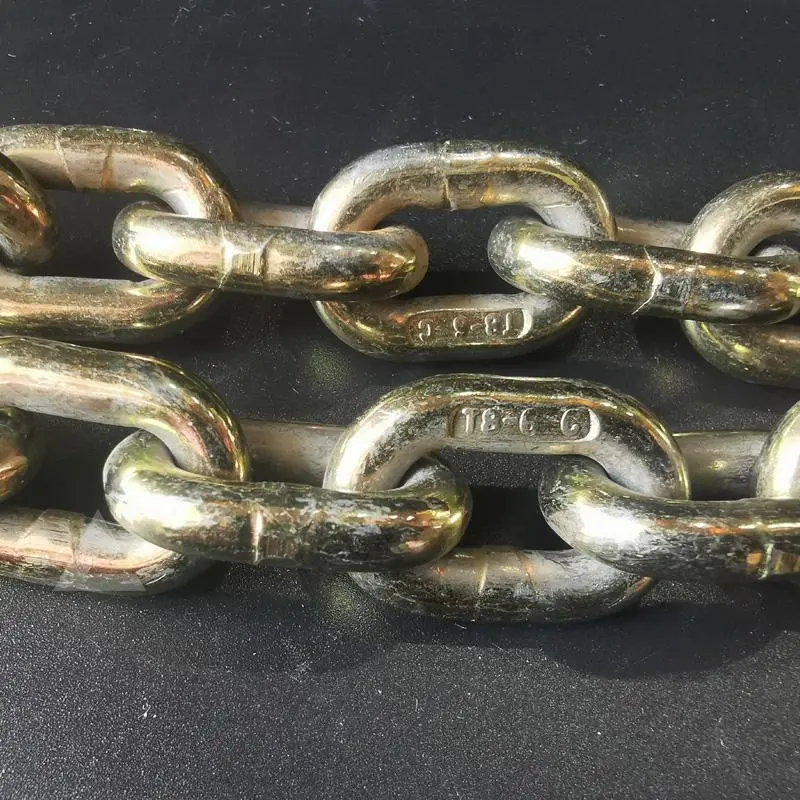
5. Marking: Chains that comply with DIN 766 specifications must have a permanent marking indicating the manufacturer's identification, the chain size, and the minimum breaking load.
How to Select the Right DIN 766 Chain
Determine Load Requirements: Consider factors like static, dynamic, and shock loads.
Choose Chain Size: Select the size based on wire diameter as per the DIN 766 standard.
Check Material Compatibility: Consider corrosion resistance, temperature, and chemical exposure.
Inspect the Chain: Verify markings, dimensions, and tolerances before purchase.
Assess Connection Points: Ensure compatibility with shackles, hooks, or other connectors.
Maintenance and Inspection: Establish a schedule to check for wear and corrosion.
Safety Considerations: Prioritize proper training and follow guidelines for load limits.
Assess Costs and Longevity: Invest in high-quality chains to reduce long-term maintenance costs.
TL003 DIN766 SHORT LINK CHAIN SPECIFICATIONS
| Code |
Dia |
Inside Length |
Inside Width |
Weight |
| mm |
mm |
mm |
kg/m |
| TL003-2 | 2 | 12 | 3.5 | 0.07 |
| TL003-3 | 3 | 16 | 4.2 | 0.16 |
| TL003-4 | 4 | 16 | 5 | 0.32 |
| TL003-5 | 5 | 18.5 | 6 | 0.5 |
| TL003-6 | 6 | 18.5 | 7.2 | 0.8 |
| TL003-7 | 7 | 22 | 8.4 | 1.1 |
| TL003-8 | 8 | 24 | 9.6 | 1.4 |
| TL003-9 | 9 | 27 | 10.8 | 1.8 |
| TL003-10 | 10 | 28 | 12 | 2.2 |
| TL003-11 | 11 | 31 | 13.2 | 2.7 |
| TL003-12 | 12 | 36 | 14.4 | 3.1 |
| TL003-13 | 13 | 36 | 15.6 | 3.8 |
| TL003-14 | 14 | 41 | 16.8 | 4.4 |
| TL003-16 | 16 | 45 | 19.2 | 5.7 |
| TL003-18 | 18 | 50 | 21.6 | 7.3 |
| TL003-19 | 19 | 86 | 22.8 | 7.97 |
| TL003-20 | 20 | 89 | 24 | 9 |
| TL003-22 | 22 | 95 | 26.4 | 11 |
| TL003-23 | 23 | 97 | 27.6 | 12 |
| TL003-26 | 26 | 73 | 31.2 | 15 |
| TL003-28 | 28 | 78 | 33.8 | 18 |
| TL003-30 | 30 | 84 | 41 | 19.5 |
| TL003-32 | 32 | 90 | 43 | 23 |
Conclusion
Understanding DIN 766 chain specifications is essential for professionals working in industries where chains are used for various applications. By following the guidelines outlined in the DIN 766 standard, you can ensure that you select the right chain for your application, guaranteeing the safety, efficiency, and durability of your equipment.
Frequently Asked Questions
What is the DIN 766 standard for chains?
DIN 766 is a German standard that specifies the dimensions, tolerances, and mechanical properties of short-link steel chains used for various industrial and marine applications.
What materials are DIN 766 chains made of?
They are typically manufactured from high-quality carbon steel or alloy steel to ensure maximum strength, durability, and load-bearing capacity.
How is the size of a DIN 766 chain determined?
The chain size is determined by the nominal diameter of the wire or rod used to manufacture the individual chain links.
Why are tolerances important in DIN 766 chains?
Tolerances ensure that the dimensions (pitch, width) are consistent, which prevents the chain from slipping or jamming when used with calibrated equipment like windlasses.
What markings should be visible on a compliant chain?
A compliant DIN 766 chain should have permanent markings including the manufacturer's identification, the specific chain size, and the minimum breaking load.
How often should I inspect DIN 766 chains?
Regular inspections are recommended to check for wear, corrosion, and link deformation. A maintenance schedule should be established based on the intensity of the application.
 Mei Shen STEEL