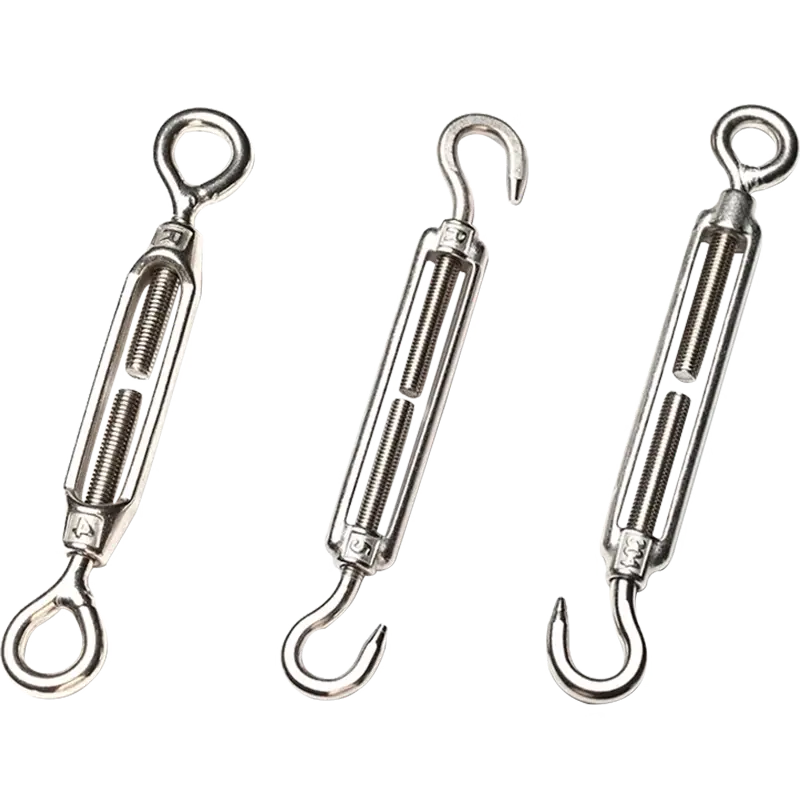
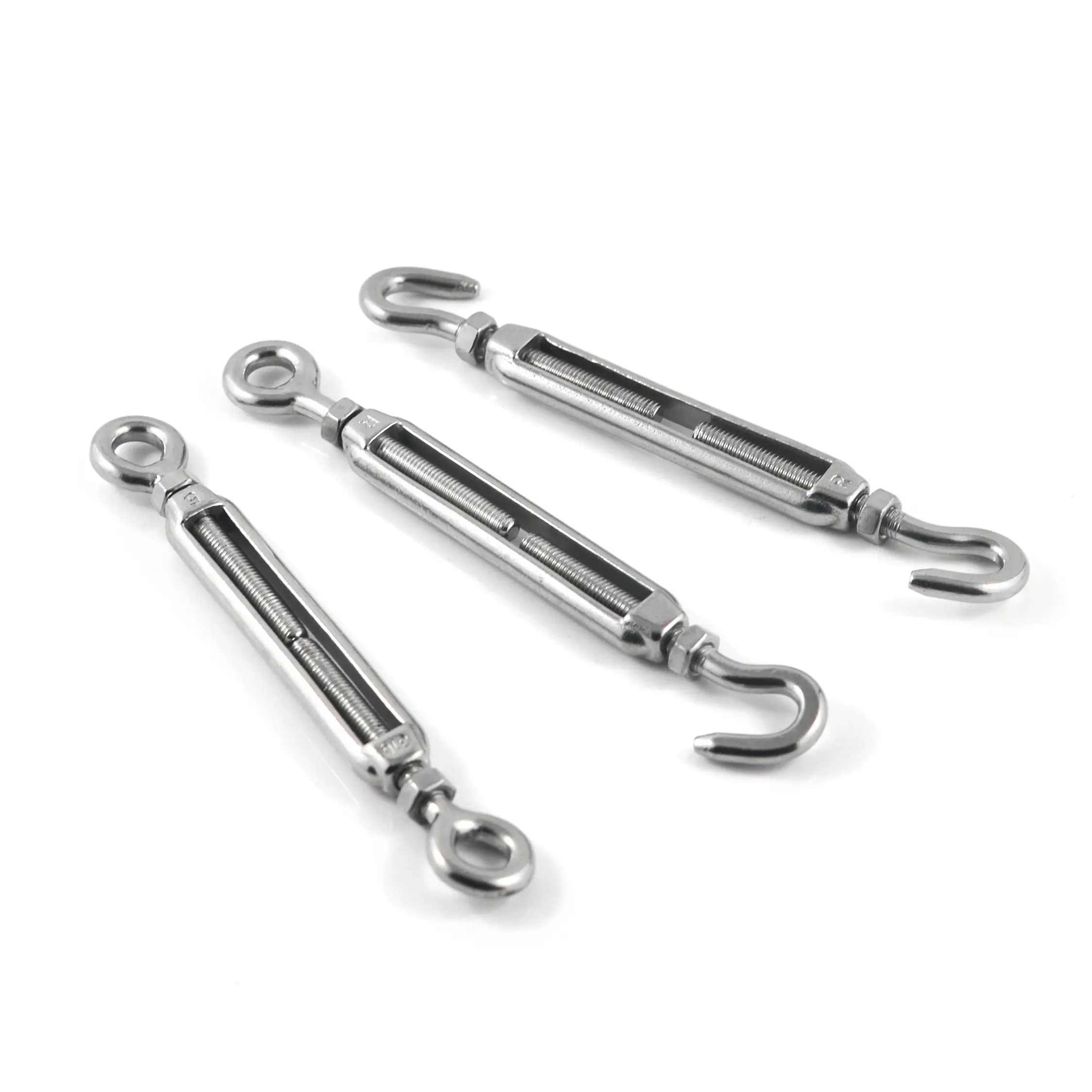
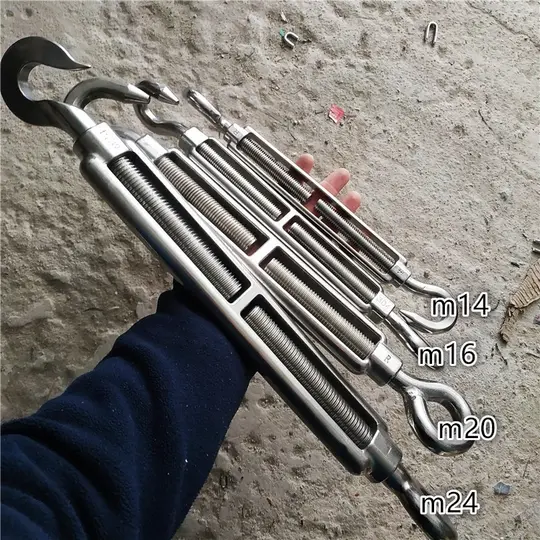
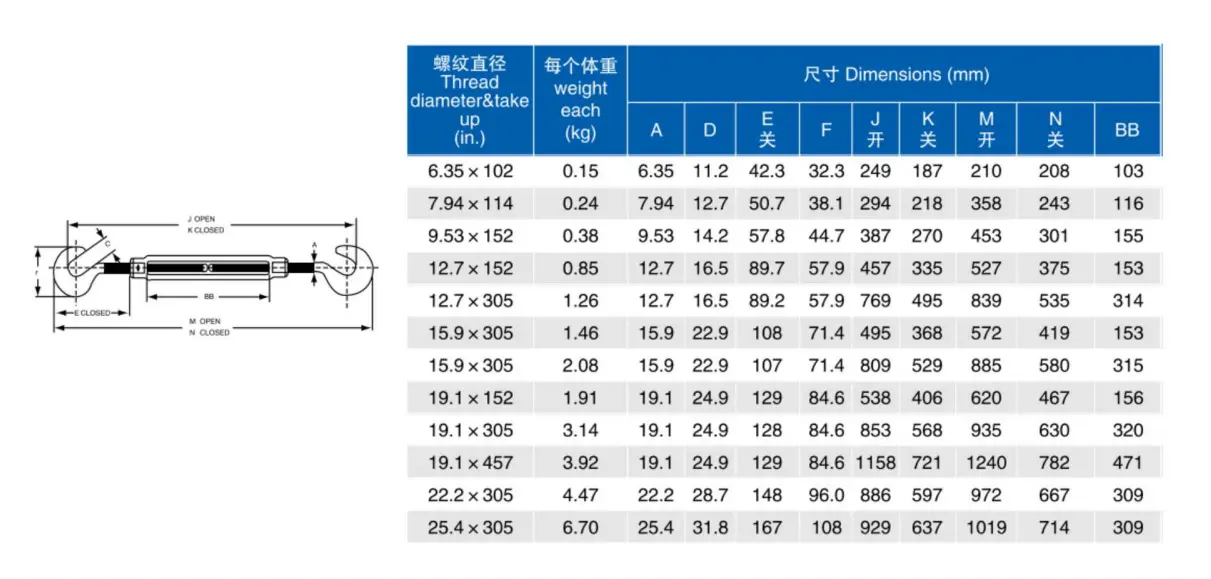
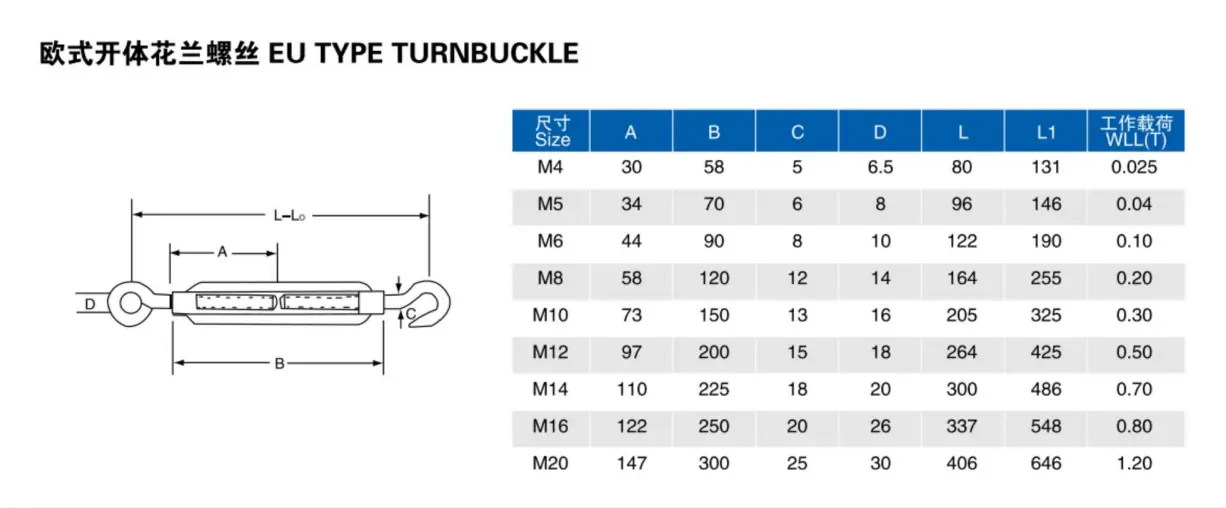
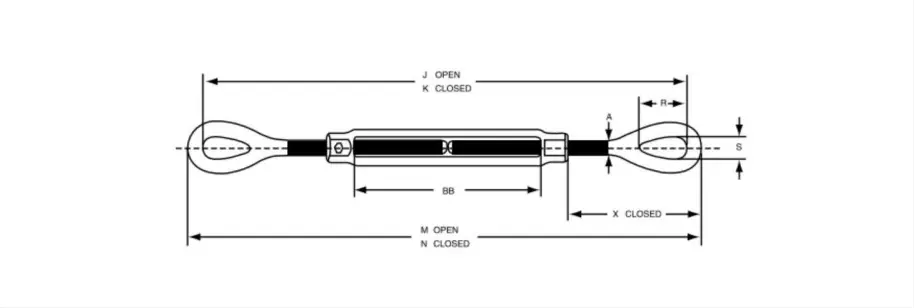
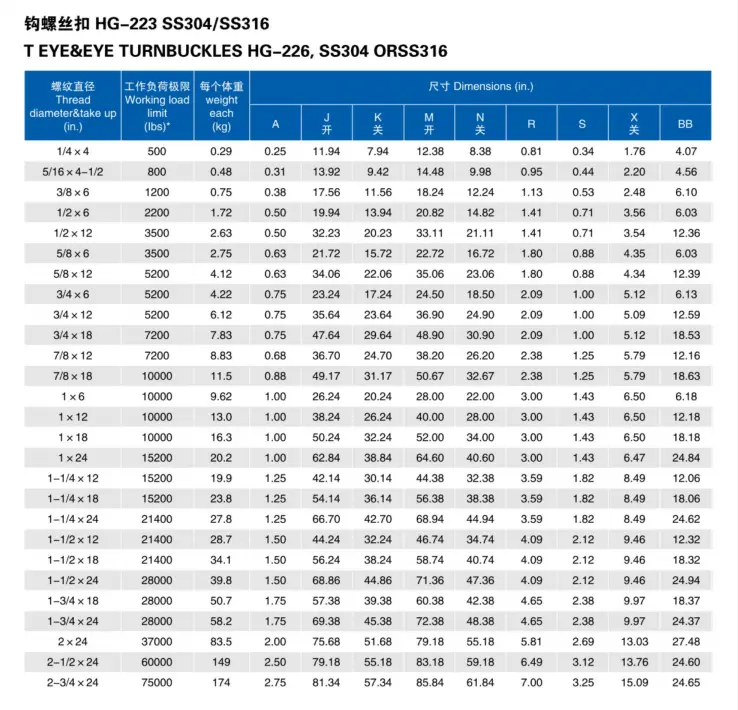
A turnbuckle (also known as a turnbuckle or rigging bolt) is a very important rigging accessory, its primary function being to secure and adjust rigging tension.
The following is a detailed description of it:
⚙️ 1. Structure
A turnbuckle consists of three main parts:
🔸
The sleeve (or turnbuckle): The central body, which can be open, annular, tubular, or closed, with internal threads at both ends.
🔸
Two screws: These are inserted into the sleeve at either end. Uniquely, the threads of these two screws are in opposite directions, with one end having a left-hand thread and the other a right-hand thread.
🔸
Connectors: The outer ends of the screws are typically connected to various end fittings for attaching cables, pull rods, chains, and other applications. Common connector types include:
• O-type (eye/ring): Used for connecting rings.
• C-type (hook): Used for quick attachment and detachment.
• S-type (fork/U): Used for connecting components with pins.
• Type CO, OO, and CC: Indicates the type of connector used at each end.
🔄 2. Working Principle
When the central sleeve is rotated, the two screws simultaneously tighten or extend into the sleeve due to the opposite thread directions of the screws at each end. This action allows precise adjustment of the tension (pull) and length of cables or tie rods.
🏗️ 3. Main Applications
Turnbuckles are widely used and can be found in almost any application requiring tension adjustment or tie rod fixation:
✔
Steel Structure Engineering: Used for connecting and length adjustment of tie rods, braces, or embedded components.
✔
Bridges and Towers: Used for tension adjustment of cables and diagonal stays.
✔
Container Transport: Used for tying and tightening containers on ships.
✔
Stage and Performance Equipment: Used for securing hoisted objects or background trusses.
✔
Marine and Offshore Engineering: Used for adjusting ship rigging or cables.
✔
Gardening and Agriculture: Used for greenhouses, windbreaks, and other applications.
🛡️ 4. Materials and Classifications
🔹
Material: Common materials include ordinary carbon steel, alloy steel, and stainless steel.
🔹
Processing: Processing methods include casting, forging (which offers higher strength and is often used in critical lifting and load-bearing applications), and welding.
❓ FAQ
Q1: How do I choose between Eye, Hook, and Jaw turnbuckle ends?
Eye ends are used for permanent connections with shackles or bolts. Hook ends are ideal for temporary applications where quick attachment is needed. Jaw (fork) ends provide a secure connection to fixed points using a pin and cotter.
Q2: Why are turnbuckle threads designed in opposite directions?
The opposite threads (left-hand and right-hand) allow both screws to move inward or outward simultaneously when the central sleeve is rotated, enabling the adjustment of tension without twisting the attached cables.
Q3: Which material is best for marine environments?
Stainless steel (specifically Grade 316) is the preferred choice for marine environments due to its high resistance to corrosion and rust in saltwater conditions.
Q4: What is the difference between forged and cast turnbuckles?
Forged turnbuckles are hammered into shape, resulting in a stronger, more durable product suitable for heavy-duty lifting and safety-critical applications. Cast turnbuckles are formed by pouring molten metal into a mold and are typically used for lighter, non-critical decorative or light-tensioning tasks.
Q5: How can I prevent a turnbuckle from loosening over time?
To prevent loosening caused by vibration or movement, you can use lock nuts (jam nuts) on the screws or wrap the assembly with safety wire to ensure the sleeve remains in its set position.
Q6: Do turnbuckles require regular maintenance?
Yes, it is recommended to regularly inspect for signs of wear, corrosion, or thread damage. Applying a light lubricant to the threads can prevent seizing and ensure smooth adjustment.
 Mei Shen STEEL