Oilfield Ropes work quietly behind drilling, lifting, and well-service operations, yet their selection can affect load control and equipment reliability. For global buyers, the right rope depends on more than breaking strength. Construction, core type, diameter, corrosion protection, and compatibility with sheaves all matter. A rope that looks robust on a supplier’s specification sheet may still perform poorly if it does not match the operating system. Small details matter.
The International Energy Agency’s Oil 2024 report projects global oil demand will rise by about 3.2 million barrels per day between 2023 and 2030. It also forecasts production capacity growing faster than demand. These figures describe the wider market, not rope consumption. Still, they point to continuing investment in energy operations, where lifting and handling equipment must be selected carefully. Buyers should check technical data against the actual duty cycle, environment, and maintenance plan.
This guide compares ten common Oilfield Ropes, including wire-rope constructions used in drilling and material handling. It focuses on practical distinctions: flexibility, abrasion resistance, load performance, and inspection needs. API Specification 9A provides a recognized framework for steel wire rope used in the petroleum and natural gas industries, but compliance alone does not guarantee suitability for every application. Procurement teams should verify current specifications, manufacturer documentation, and site requirements. No single rope is best everywhere. That is easy to forget when price and delivery dominate a purchase.
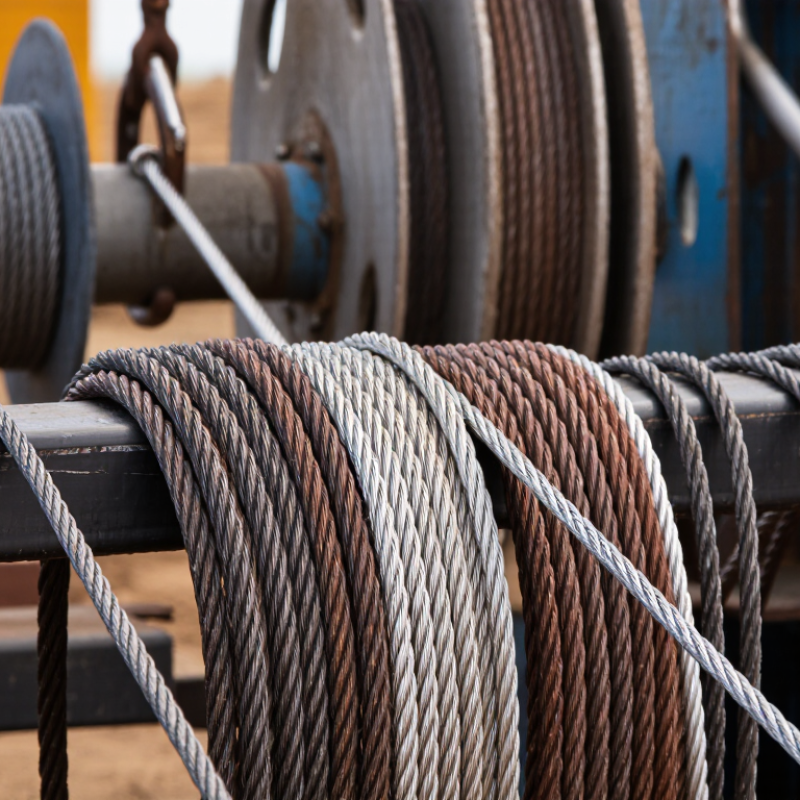
What Oilfield Ropes Are and Where They Are Used
Oilfield ropes are load-bearing lines used to lift, pull, lower, or control equipment around drilling and production sites. Most are steel wire ropes, built from wires, strands, and a central core. Their design affects strength, flexibility, fatigue resistance, and handling safety. The ten common types include drilling line, sand line, wireline, slickline, braided line, winch line, crane rope, tugger line, guy line, and socketed cable.
Drilling lines support the traveling block during hoisting operations. Sand lines move tools, bailers, and cleaning equipment inside wells. Wireline and slickline products lower gauges, plugs, cutters, and other downhole tools. Braided lines can provide flexibility for intervention work. Winch and tugger lines handle pipe, valves, hoses, and maintenance loads on the rig floor. Crane ropes lift tubulars and machinery, while guy lines help stabilize temporary structures.
Selection depends on load, rope diameter, lay, core construction, drum size, sheave condition, corrosion exposure, and bending frequency. A rope exposed to salt spray may need stronger corrosion protection and more frequent inspection. Operators should check broken wires, flattened strands, birdcaging, kinks, heat damage, and unusual diameter changes. In practice, labels can be confusing. A “stronger” rope may perform poorly when repeated bending dominates the job. Site records, manufacturer data, inspection training, and measured working loads should guide every replacement decision. Tension, temperature, and human handling still matter.
How Oilfield Ropes Are Classified by Material and Construction
Oilfield ropes are not one uniform product. Buyers usually classify them by material, then by construction. Steel wire rope suits hoisting, drilling, and heavy pulling. Its strength comes from steel wires twisted into strands around a core. Fiber ropes use polyester, nylon, polypropylene, or high-modulus polyethylene. Each material behaves differently under heat, moisture, abrasion, and cyclic loading. Polyester offers low stretch and stable performance around water. Nylon absorbs shock well but stretches more. Polypropylene is light and floats, yet heat resistance remains limited. High-modulus fibers reduce weight, but sharp edges can damage them quickly.
Construction changes handling as much as material does. Three-strand rope is simple, economical, and easy to splice. Braided rope handles smoothly and resists kinking during repeated movement. Double-braided designs add a protective outer cover and a load-bearing core. Wire ropes may be rotation-resistant, compacted, or designed with independent wire-rope cores. These patterns affect flexibility, torque, crush resistance, and fatigue life. A six-strand wire rope may lift heavily, but it still needs the correct sheave size and lubrication. Small details matter.
For global buyers, selection should match the actual duty cycle. Check working load, temperature, chemicals, bend radius, and termination method. Ask for test reports, traceable material records, and clear inspection guidance. A rope can look sound while hiding internal damage. That is easy to miss. One weakness in many comparison tables is their focus on breaking strength alone. In practice, installation quality and operator habits can shorten service life sharply. The most suitable of ten rope types is not always the strongest. It is the one whose material and construction fit the load, environment, and maintenance capacity.
Ten Common Types of Oilfield Ropes for Global Buyers
Oilfield rope selection starts with the job, not a catalog label. The IEA’s Oil 2024 report estimates that global oil demand reached 102.2 million barrels per day in 2023, underscoring the scale of equipment operating across varied fields. That figure does not predict rope demand, but it shows why reliable lifting and intervention equipment matters. API Recommended Practice 9B addresses application, care, and use of wire rope in oilfield service. Field checks still matter: mud, sharp sheaves, shock loading, and poor spooling can shorten service life.
Ten common types serve different tasks: drilling line, sand line, hoisting line, winch line, guyline, swabbing line, slickline, braided line, electric wireline, and synthetic-fiber rope. Drilling and hoisting lines handle heavy loads; sand lines support specific well-service operations. Slickline and braided lines enter wells for intervention, while electric wireline carries measurement signals. Winch lines move equipment, and guylines stabilize structures. Synthetic rope can reduce handling weight, but heat, abrasion, and compatibility require careful review. The categories can overlap in trade usage. That is worth checking. Match construction, diameter, core, and rated strength to the equipment, then inspect for broken wires, corrosion, crushing, and wear. A rope’s stated capacity alone is not a safe selection method.
Top 10 Types of Oilfield Ropes for Global Buyers — Ten Common Types of Oilfield Ropes for Global Buyers
| No. |
Rope Type |
Typical Construction or Material |
Common Oilfield Applications |
Key Selection Considerations |
| 1 |
Drilling Line |
Steel wire rope commonly supplied in constructions such as 6×19 or 6×26 Warrington-Seale; exact construction varies by duty and equipment. |
Runs through the crown and traveling blocks and connects to the drawworks for raising and lowering the drilling assembly. |
Confirm the rig’s specified diameter, construction, grade, lay, and required line length. Inspect regularly for wear, broken wires, corrosion, and deformation. |
| 2 |
Sand Line |
Steel wire rope; constructions such as 6×7 or 6×19 may be used depending on the service and equipment. |
Operates bailers and other tools used to remove sand or debris from a well. |
Consider abrasion, bending over sheaves, tool weight, and the service rig’s specifications. Keep the line properly spooled and inspect it for localized damage. |
| 3 |
Tubing Line |
Steel wire rope selected for the service rig’s hoisting system; construction and core type depend on the manufacturer’s requirements. |
Supports hoisting operations associated with running or pulling tubing during well servicing. |
Match the rope to the rig, sheave sizes, load, and reeving arrangement. Account for repeated bending and the condition of the drum and sheaves. |
| 4 |
Swab Line |
Steel wire rope designed for repeated movement through a sheave system; construction is selected for the specific swabbing unit. |
Raises and lowers a swab tool during well-servicing operations to remove fluid from a well. |
Evaluate operating load, line speed, bending fatigue, and compatibility with the winch and sheaves. Follow the equipment maker’s inspection and replacement criteria. |
| 5 |
Rotation-Resistant Wire Rope |
Multi-strand construction, commonly described by configurations such as 18×7 or 19×7. |
Hoisting applications where limiting load-induced rotation is important, subject to equipment approval. |
Requires careful handling, correct installation, and construction-specific inspection. Do not substitute it for a conventional rope without checking the equipment requirements. |
| 6 |
Compacted-Strand Wire Rope |
Strands are mechanically compacted during manufacture, producing a smoother outer profile than a comparable un-compacted construction. |
Selected for some heavy-duty hoisting and drilling applications where rope performance and wear characteristics suit the system. |
Check compatibility with sheave grooves and drum design. Selection should be based on the rope’s certified properties and the rig manufacturer’s guidance. |
| 7 |
Galvanized Wire Rope |
Carbon-steel wires with a zinc coating for added corrosion protection. |
General oilfield service, support, and rigging applications where exposure to moisture or outdoor conditions is expected. |
Galvanizing can improve corrosion resistance, but it does not eliminate inspection or maintenance needs. Confirm that the rope’s strength and construction meet the load requirements. |
| 8 |
Stainless-Steel Wire Rope |
Wire rope made from corrosion-resistant stainless-steel grades, with grade and construction selected for the environment and duty. |
Corrosive or wet environments and auxiliary applications where corrosion resistance is a priority. |
Compare the certified breaking force and fatigue performance with the required duty; stainless-steel rope is not automatically a direct substitute for carbon-steel lifting rope. |
| 9 |
Independent Wire Rope Core (IWRC) Rope |
Steel wire rope with an independent wire-rope core supporting the outer strands. |
Heavy-duty hoisting and drilling duties where a steel core is specified for the operating conditions. |
Core type affects rope behavior and must match the application. Verify the specified construction, lubrication, diameter, and compatibility with the sheave system. |
| 10 |
Fiber-Core Wire Rope |
Steel wire rope with a natural or synthetic fiber core, depending on the product specification. |
Some general-purpose hoisting and handling duties where a fiber core is permitted by the equipment and operating conditions. |
Fiber cores can be more sensitive to heat, moisture, and crushing than steel cores. Confirm that the core type is suitable for the load, environment, and equipment. |
| Buyer note: Rope names and constructions can overlap, and the examples above are not interchangeable specifications. Before purchase, verify the required diameter, construction, grade, core, lay, certification, and inspection criteria against the rig or equipment manufacturer’s documentation and applicable standards. |
Key Performance Differences Among Oilfield Rope Types
Top 10 Types of Oilfield Ropes for Global Buyers
Key Performance Differences Among Oilfield Rope Types
Oilfield rope selection depends on load, movement, heat, abrasion, and inspection access. Drilling lines handle repeated hoisting cycles, while sand lines support lighter, intermittent pulling. Wireline ropes favor controlled descent and accurate tool positioning. Slickline cables are thinner and more responsive, but they tolerate less abuse. Braided steel ropes can resist crushing better around multi-layer drums. That difference becomes obvious during fast spooling.
Guy lines prioritize stability rather than frequent movement. Crane ropes combine high breaking strength with bending resistance. Winch ropes need dependable grip and steady recovery under changing loads. Synthetic ropes reduce weight and are easier to handle, yet sharp edges can damage them quickly. Mooring ropes manage tension over longer periods, where stretch and water absorption become critical.
Heat changes everything. Steel ropes usually retain better performance near hot equipment, but corrosion can develop inside unseen strands. Synthetic ropes resist some chemicals and float in water, although ultraviolet exposure may weaken them. Field teams should check rope diameter, lay distortion, broken wires, glazing, and drum condition. Small details matter.
In practice, no rope wins every duty. A line that performs well on a clean drum may fail on a rough, misaligned system. I have seen operators focus on breaking strength and overlook fatigue cycles. That is an imperfect decision, but a common one. Actual load history, maintenance quality, and handling habits often matter as much as the rope specification.
How to Select and Maintain Oilfield Ropes for Different Operations
Top 10 Types of Oilfield Ropes for Global Buyers
Selecting oilfield rope starts with the operation, not the price. Drilling lines need fatigue resistance during repeated hoisting. Wireline and slickline require controlled diameter and smooth surfaces. Sand lines, braided lines, winch lines, crane ropes, snubbing lines, guy lines, and mooring ropes each face different loads. For offshore work, select ropes with verified breaking strength, corrosion resistance, and suitable construction. API RP 9B provides recognized guidance for drilling-line selection, handling, and inspection. ISO 4309 also supports discard decisions for lifting ropes.
Field crews should inspect ropes before every shift. Look for broken wires, birdcaging, crushing, heat damage, flattened sections, and rust hidden beneath lubricant. Measure diameter at several points, not only near the termination. Keep a traceable log with load history, inspection dates, and replacement reasons. OSHA’s 2022 Census of Fatal Occupational Injuries recorded 395 fatal falls in construction. That figure is not oilfield-specific, but it shows why lifting controls deserve constant attention. I still see teams over-trust visual checks. That is a weakness.
Tips: Match rope construction to duty cycle and bending frequency. Keep ropes clean and properly lubricated. Store them off the ground, away from chemicals and standing water. Rotate fleet stock when practical. Replace ropes when API or site criteria are reached, even if the rope still appears usable. A second inspection can prevent a costly assumption.
FAQS
Steel wire ropes handle heavy lifting and pulling. Fiber ropes use materials such as polyester, nylon, polypropylene, or high-modulus fibers. Each responds differently to heat, moisture, abrasion, and repeated loading.
Three-strand ropes are economical and easy to splice. Braided designs handle smoothly and resist kinking. Double-braided ropes add an outer cover around a load-bearing core. Wire-rope patterns affect flexibility, torque, and fatigue life.
Drilling and hoisting lines are made for heavy loads and repeated lifting. Drilling lines need fatigue resistance. The rope must also match the equipment, sheave size, and operating conditions.
Check working load, temperature, chemicals, bend radius, and termination method. Confirm diameter, core, construction, and rated strength. Test reports and traceable material records are useful, but a strong rating alone is not enough.
Synthetic ropes can be lighter and easier to handle. Polyester stretches little and performs steadily around water. Nylon absorbs shock but stretches more. Heat and sharp edges can damage some synthetic fibers quickly.
Look for broken wires, corrosion, crushing, birdcaging, heat damage, flattened sections, and wear. Measure diameter at several points. Damage can hide beneath lubricant, so visual checks have limits.
Crews should inspect ropes before every shift. Keep records of inspection dates, load history, and replacement reasons. A second inspection can catch a detail that one quick look misses.
Keep ropes clean and lubricated where appropriate. Store them off the ground, away from chemicals and standing water. Follow site or recognized inspection criteria when deciding on replacement, even if a rope still looks usable.
Conclusion
Oilfield Ropes are essential lifting, pulling, hoisting, and handling components used across drilling sites, well-servicing operations, offshore platforms, and equipment maintenance. Their design must match demanding conditions such as heavy loads, repeated bending, abrasion, moisture, chemicals, temperature changes, and limited installation space. This overview explains how oilfield ropes are classified by material and construction, including steel-wire, synthetic-fiber, stranded, braided, coated, compacted, rotation-resistant, high-strength, corrosion-resistant, and low-stretch designs.
The article also compares the key performance differences among ten common rope types, focusing on strength, flexibility, weight, durability, elongation, fatigue resistance, and environmental suitability. Global buyers will learn how to select the right rope according to load requirements, operating conditions, equipment compatibility, and maintenance expectations. Proper inspection, lubrication where applicable, cleaning, storage, and timely replacement are also emphasized to support safer operations, extend service life, and maintain reliable performance in demanding oilfield applications.

 Mei Shen STEEL