Industrial lifting depends on a component that is easy to overlook: the rope connecting the crane to its load. Industrial Crane Rope is not one universal product. Its construction, core, diameter, and resistance to crushing affect how it performs on a particular hoist or sheave system. Small differences matter. A rope that bends repeatedly over a compact sheave may wear differently from one exposed to abrasion, shock loading, or corrosive conditions outdoors.
Reliable selection starts with equipment requirements and documented inspection practices, not a sales label. ISO 4309:2017, Cranes—Wire ropes—Care and maintenance, inspection and discard, sets out guidance for examining crane ropes and deciding when they should be removed from service. ASME B30.30-2019 also addresses ropes used in lifting equipment. These technical references help frame the discussion, but they do not replace the crane manufacturer’s specifications or a competent person’s assessment. The details matter.
This guide compares common rope types, including rotation-resistant, compacted-strand, and conventional stranded constructions. It explains where each design may fit, and where trade-offs appear in bending fatigue, handling, and resistance to rotation. No type wins every application. Even a well-matched rope can deteriorate early if reeving, lubrication, or inspection is neglected. The sections ahead connect design features with real operating conditions, so buyers and maintenance teams can ask better questions before a rope is installed.
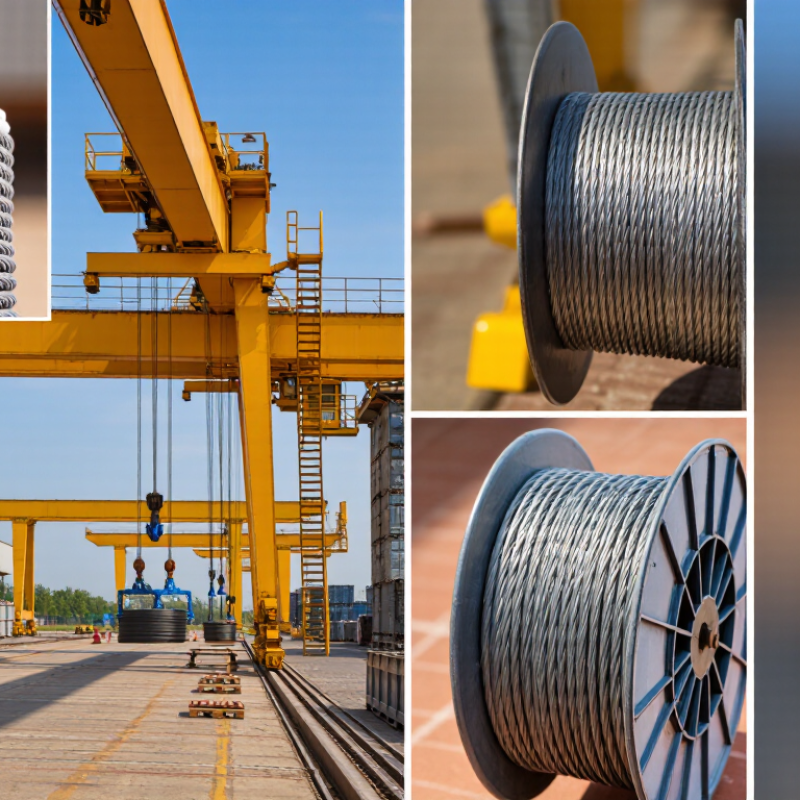
What Are the Top Industrial Crane Rope Types?
How Industrial Crane Ropes Are Built and Classified
Industrial crane ropes are classified by construction, core, lay, and strength grade. A designation such as 6×19 describes a six-strand rope family, with nominal wire counts that can vary by design. The core may be fibre or an independent wire-rope core (IWRC). Fibre cores can offer flexibility, while IWRC designs generally provide greater support under crushing loads. Regular lay and Lang lay describe how wires and strands run around the rope; each affects handling, wear, and resistance to rotation. Details matter. A familiar label does not tell the whole story.
ISO 2408:2017 includes rope strength grades such as 1770 and 1960 MPa. These figures describe nominal wire tensile-strength grades, not the rope’s complete breaking force; diameter and construction also matter. ISO 4309:2017 addresses inspection and discard criteria, including broken wires, diameter reduction, corrosion, and deformation. In practice, inspectors measure the rope and examine high-wear zones near sheaves and drum crossover points. Small defects can be easy to miss. Selection should match the crane’s duty, sheave geometry, and reeving arrangement, using the manufacturer’s rope specification and applicable inspection guidance. There is no universal best type. A rope that handles one lift smoothly may wear quickly in another setup.
Wire rope designations show the number of strands followed by the nominal number of wires per strand. These examples illustrate common constructions—not load ratings. Rope performance also depends on factors such as wire grade, core, lay, diameter, and the crane application; select rope according to the equipment manufacturer’s specifications.
Industrial crane ropes differ by strand count, wire arrangement, and core. Common constructions include 6x19 and 6x36, where the first number identifies the strands and the second indicates wires per strand. A 6x19 rope generally has larger outer wires and better resistance to abrasion. A 6x36 construction uses more, finer wires, which often makes it more flexible around sheaves. The exact performance depends on rope design, not just its label.
Tips: Match rope construction to the crane’s sheave diameter, lifting duty, and required rotation resistance. Check the equipment specifications before replacement.
Core choice matters, too. An independent wire rope core can provide stronger support under high loads and heat, while a fiber core can offer greater flexibility in some applications. Rotation-resistant ropes use multiple strand layers arranged to reduce twisting under suspended loads. They can help control load spin, but may need more careful handling. Small detail. Big consequence. A smooth-looking rope is not necessarily serviceable; broken wires, corrosion, kinks, or crushed sections need qualified inspection. There is no single best construction for every crane. A rope that runs quietly on one hoist may wear faster on another.
| Wire Rope Construction | Typical Construction | Key Characteristics | Common Crane Uses | Selection Considerations |
|---|---|---|---|---|
| 6×19 Seale | Six strands around a core; each strand commonly has a 1–9–9 wire arrangement. | Relatively large outer wires provide good resistance to external abrasion. It is generally less flexible than finer-wire constructions. | General hoisting and crane applications where resistance to wear from sheaves or drums is important. | Check sheave and drum diameters, fleet angle, and the required bending-fatigue life. Exact wire arrangements can vary by rope specification. |
| 6×36 Warrington-Seale | Six strands around a core, with a denser arrangement of wires in each strand; commonly specified within the 6×36 class. | More flexible than many 6×19-class ropes and suited to repeated bending. The smaller outer wires can be more susceptible to abrasive wear. | Hoist ropes and other crane duties involving frequent bending over sheaves. | Balance bending-fatigue requirements against abrasion exposure. Confirm the actual strand pattern and rope grade in the rope specification. |
| 8×19 | Eight strands around a core, typically with a 19-wire strand pattern. | The additional strands can give a more flexible rope and a smoother running surface over sheaves than many six-strand constructions. | Crane hoists and reeving systems where flexibility and smooth operation are priorities. | Verify compatibility with the crane’s sheaves, drum grooves, and reeving arrangement; rope diameter alone is not enough to establish suitability. |
| Rotation-Resistant 19×7 | Typically two layers of strands arranged in opposing directions around a core. | Designed to reduce torque and load-induced rotation compared with conventional single-layer ropes. Rotation resistance is not the same as being completely non-rotating. | Single-part or multi-part hoisting applications where load spin needs to be controlled, subject to the crane design. | Use only where permitted by the crane manufacturer or equipment specification. Correct reeving, handling, and installation are especially important. |
| Rotation-Resistant 35×7 | Multiple layers of strands in opposing directions; a common rotation-resistant construction family. | Provides a high degree of resistance to rotation under suitable operating conditions and is generally more complex to handle than ordinary six-strand rope. | Crane hoisting duties with longer free rope lengths or loads that are sensitive to rotation, when specified for the application. | Follow the crane’s requirements for rope type, reeving, end connections, installation, and inspection. Avoid mixing different rope constructions in one system. |
| Compacted-Strand Rope | Strands are compacted during manufacture; the rope may use a six- or eight-strand construction. | Compaction creates a smoother, denser rope surface and can increase metallic cross-sectional area for a given nominal diameter. Performance depends on the specific design. | Heavy-duty crane hoisting where the rope specification calls for a compacted construction. | Check compatibility with the drum groove and sheaves. Compacted construction is a strand feature, so it should be specified alongside the rope’s core and lay. |
Note: Wire rope suitability depends on the complete specification, including rope grade, core, lay, diameter, lubrication, and duty cycle. Select and inspect ropes according to the crane documentation and applicable safety requirements.
Industrial crane ropes are often grouped by how much they resist twisting under load. Rotation-resistant ropes use multiple strand layers, typically laid in opposing directions, to reduce rotation. This helps keep a suspended load steadier during long lifts or when it hangs freely.
That matters. But “rotation-resistant” does not mean rotation-proof; load, lift height, reeving, and rope condition all affect performance.
Non-rotation-resistant ropes have a simpler construction and may suit crane arrangements that control load rotation through reeving or other equipment. They can be appropriate for shorter lifts or guided loads, when the crane manufacturer permits them.
A common selection mistake is focusing only on rope diameter while overlooking the lifting arrangement. Check the crane’s specifications and the rope’s rated capacity before choosing.
During inspections, look for broken wires, kinks, crushed sections, corrosion, and birdcaging. Small details count.
If rotation appears during a lift, stop and have a qualified person assess the setup; changing rope type alone may not address the cause.
A crane’s rope is not chosen by capacity alone. Boom geometry, reeving pattern, drum grooves, and sheave diameter all influence rope behavior. A wire rope with many small wires can bend more readily over tight sheaves, but may wear faster where abrasion is severe. Fewer, larger wires often tolerate rough contact better, though they can be less flexible. Rotation-resistant constructions help control load spin on tall lifts or multi-part reeving. They are not a universal fix. Details matter.
The task shapes the rest. Frequent starts and stops increase bending fatigue, while dust can work into the rope and accelerate wear. Moisture and chemicals may call for protective materials or coatings, within the equipment maker’s limits. Synthetic rope can reduce weight in suitable systems, but heat, sharp edges, and drum compatibility need close review. A rope that looks sound can still have internal damage, so inspection records and discard criteria matter.
Tips: Match rope construction to the crane manual, reeving, sheaves, and duty cycle. Check lubrication, broken wires, diameter loss, and kinks during inspections. When conditions conflict, consult a qualified inspector; a quick visual check can miss hidden wear.
When comparing industrial crane rope types, start with the actual duty cycle, not a brochure’s headline strength. A wire rope may suit repeated lifting and tolerate contact with rough sheaves, while synthetic rope can reduce suspended weight. The best choice depends on load, lift height, reeving arrangement, and operating environment. That matters.
Fatigue resistance is critical when a rope bends over sheaves many times per shift. Check the groove. A rope that is too large, too small, or poorly matched to the sheave can wear unevenly. Abrasion, crushing, and rotation under load also affect service life; rotation-resistant constructions may help control load spin, but still require correct installation and inspection.
Moisture, grit, chemicals, and temperature can change performance. Corrosion may weaken wire rope internally before surface damage looks severe, while synthetic fibers can be vulnerable to heat or cuts. Compare required breaking strength with the crane’s rated capacity, but do not treat that figure as a working-load limit. Follow the crane and rope manufacturers’ guidance, and keep records of inspection findings. In practice, inspection intervals can be harder to maintain than expected, especially on busy sites. A technically suitable rope is not a good choice if crews cannot inspect it consistently.
It identifies a rope construction family with six strands. The exact wire count can vary by design.
Fibre cores can make a rope more flexible. An independent wire-rope core generally offers greater support under crushing loads. Details matter.
They describe how wires and strands run around the rope. Each arrangement affects handling, wear, and resistance to rotation.
No. They describe nominal wire tensile-strength grades. Diameter and construction also affect the rope’s complete breaking force.
Check the crane’s manual, reeving pattern, sheaves, drum grooves, and duty cycle. A rope suited to one lift may wear quickly in another setup.
Check broken wires, diameter loss, corrosion, deformation, and kinks. Examine high-wear areas near sheaves and drum crossover points. Small defects hide.
It may help control load spin on tall lifts or multi-part reeving. It is not a universal fix, and installation still matters.
It can reduce suspended weight in suitable systems. Heat, sharp edges, and drum compatibility need careful review. I’d double-check those limits.
Internal damage may not show clearly during a quick visual check. Records help track findings, though busy crews may find consistent inspections difficult. That deserves thought.
Industrial Crane Rope is built from individual steel wires twisted into strands, which are then arranged around a core. Differences in wire size, strand patterns, core design, and lay create rope constructions suited to a range of industrial crane applications. Common choices include standard multi-strand ropes for general lifting and specialized constructions designed to balance flexibility, strength, and resistance to wear.
A key distinction is whether a rope is rotation-resistant or non-rotation-resistant. Rotation-resistant designs help limit load spin, while other ropes may suit lifting arrangements where rotation is less critical. Selecting a rope depends on crane design, reeving configuration, lift height, load characteristics, and operating conditions. Comparing breaking strength, flexibility, fatigue life, abrasion resistance, and ease of inspection helps identify a suitable type. The right choice supports reliable lifting performance while matching the demands of the task and the crane system.

Mei Shen STEEL